
Latent Learning Psychology Definition

Latent Learning Psychology Definition

We introduce a clear, glossary-style entry on an important concept in psychology. We define latent learning as knowledge gathered from the environment that did not appear in behavior right away but surfaced when motivation or circumstances changed.

Our aim is to explain how this kind of learning can happen without reinforcement. In plain terms, no immediate reward or punishment needed to produce stored information that later guides action.

We will outline the historical tests that proved this idea, such as classic maze studies that showed animals formed mental maps before they ever had reason to show them. This sets expectations: a concise definition, origins, and experimental evidence.

Finally, we frame the idea as “learning first, performance later.” We link the concept to everyday examples, like quietly picking up a route and using that knowledge when needed.

– We define the concept and how it differed from strict stimulus-response views.

– We note that reinforcement was not required for knowledge to form.

– We preview classic experiments and real-life links to follow in later sections.

Latent Learning Psychology Definition and What Makes It Unique

We explain a form of learning that forms internal knowledge even when no immediate reward or punishment is present. This hidden acquisition can later guide action once motivation rises.

A visually captivating representation of "latent learning" depicted in an academic environment. In the foreground, a diverse group of students engage in a lively discussion, their expressions reflecting curiosity and introspection, wearing professional business attire. In the middle ground, a large chalkboard filled with complex diagrams illustrating learning processes and pathways, symbolizing the mind’s hidden knowledge. The background features a warm, inviting library with bookshelves and soft lighting, creating a scholarly atmosphere. The scene is captured with a slight upward angle to emphasize the students' engagement with their surroundings, while warm, diffused light envelops the room, evoking a sense of discovery and intellectual growth. The overall mood is inspiring and thought-provoking, resonating with the essence of latent learning.

Learning without reinforcement, reward, or punishment

We show that this type of learning occurs without reinforcement. Organisms gather information from an environment and store it, even when no reward appears.

Why this learning isn’t obvious until motivation changes performance

We separate learning from performance. Knowledge may sit unused until a strong motivation — hunger, safety, or a goal — triggers visible behavior.

Key terms we use

To follow the experiments and theory, we use a small set of terms consistently.

  • stimulus — an event or cue that the subject encounters
  • response — the action taken after a cue
  • environment — the stable setting where information is gathered
  • information and knowledge — the stored content that later shapes behavior

We also contrast this with observational learning: both pick up information, but one often needs social cues or visible rewards. Here, stored maps and facts form through internal processes and reveal themselves only when circumstances demand action.

Where the Concept Came From: From Blodgett to Edward Tolman

We trace the origin to early maze work that changed how psychologists thought about how animals form knowledge over time.
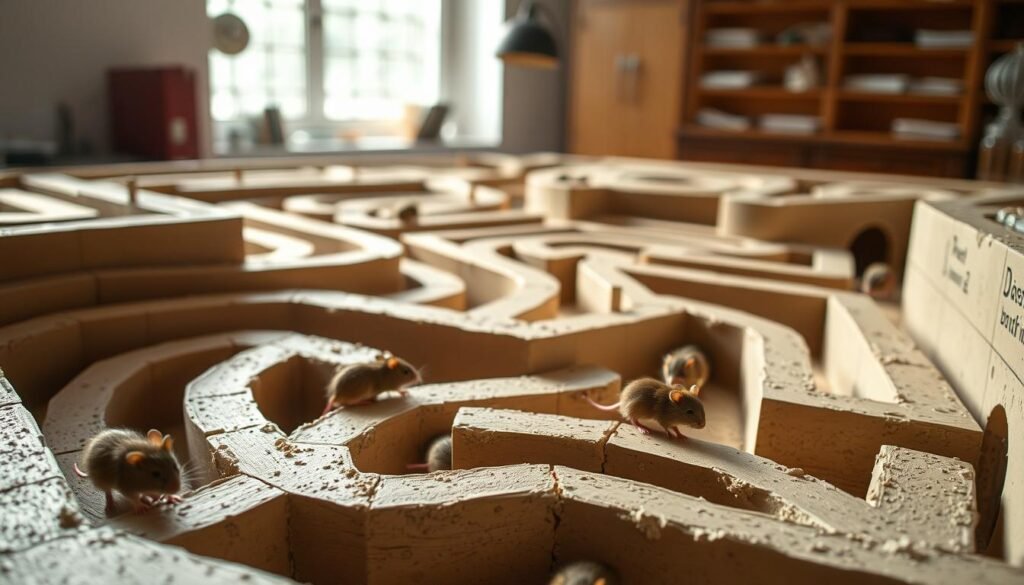
A detailed representation of a classic rat maze, filled with intricate pathways and various obstacles. In the foreground, several small brown and gray rats are actively exploring the maze, their tiny whiskers twitching in curiosity. The middle section features the maze's twists and turns, designed with high walls and hidden corners, casting delicate shadows across the paths. In the background, a soft-focused laboratory setting hints at scientific observation, with muted colors to evoke a sense of study and experimentation. The lighting is warm and natural, simulating sunlight filtering through a nearby window, creating a cozy yet intellectual atmosphere. The overall mood is one of exploration, curiosity, and the quest for knowledge, perfectly reflecting the origins of latent learning in psychology.

Hugh C. Blodgett and early maze observations

Hugh C. Blodgett in 1929 noted that rats sometimes showed better maze performance after days of exposure, even when no reward had been given.
Those patterns suggested that experience accumulated quietly and surfaced later when conditions changed.

Edward Tolman’s challenge to behaviorism

In the 1930s and 1940s, Edward Tolman ran systematic experiments with rats in mazes that popularized the idea.
Tolman argued that animals built internal maps and that reinforcement was not the only way to acquire routes.

  • Blodgett’s rodent reports planted the seed for a formal concept.
  • Tolman’s maze studies made the case testable across days and time.
  • The shift moved theory toward internal information processing rather than pure stimulus–response chains.

Tolman and Honzik’s Rat Maze Experiments and the Role of Reinforcement

We review a landmark study where three groups of rats ran a complex maze so we could test whether route knowledge forms without immediate reward.

A detailed depiction of a rat maze, showcasing intricate pathways and barriers in the foreground, where a few small brown rats are actively exploring. In the middle ground, there are sections of the maze that include small rewards like food scattered at various points, highlighting the concept of reinforcement in learning. The background features a subtle gradient of soft lighting, creating an atmosphere that is both scientific and intriguing. The scene is shot from a slightly elevated angle, giving a comprehensive view of the maze's layout. The lighting should be warm and inviting, emphasizing the rats' curiosity and activity without any distractions or text elements.

The aim and setup

The aim was to see if rats learned routes beyond simple stimulus–response patterns. Each day the rats ran the maze with a food box at the end.

How the procedure worked

Three groups ran the maze across days. Group 1 received food every day (rewarded). Group 2 had no food for Days 1–10 and food on Days 11–17 (delayed reward). Group 3 never received food.

  • All groups explored the same routes each day.
  • Food functioned as the reinforcer when it appeared.
  • Researchers tracked maze performance and errors across days.

Results and interpretation

At first, the delayed reward group behaved like the no-reward group. After Day 11 their performance improved sharply and sometimes beat the continuously rewarded group.

Researchers concluded the rats had formed a learned maze during the early, unrewarded days. Food and motivation revealed stored information; it did not create all learning on the spot.

Group Reinforcement Outcome across days
Group 1 Food Days 1–17 Steady maze performance
Group 2 No food Days 1–10; food Days 11–17 Sharp improvement after Day 11
Group 3 No food Days 1–17 Low motivation; little improvement

The authors proposed mediational processes: an internal step between stimulus and response where rats processed spatial information. This finding challenged strict reinforcement-only theories of learning in animals.

Cognitive Maps as the Mechanism Behind Latent Learning

We examine how internal maps guide behavior when animals or people face blocked paths or new goals. Tolman coined the term cognitive map to describe an internal representation of landmarks and spatial relations that stores usable knowledge.

What a cognitive map is and how it supports shortcuts and flexible routes

A cognitive map is an internal map of the environment. It records cues, landmarks, and spatial links. This map lets an animal take a shortcut or choose an alternate route when the usual way is blocked.

Rats, mazes, and internal maps: what “learning rats” implies

Rats in Tolman’s maze studies built maps during low-stakes exposure. When motivation appeared, their stored information produced rapid gains. That pattern meant these learning rats were forming internal knowledge, not just chaining responses.

Humans build cognitive maps too: commuting routes, buildings, and objects over time

We form maps of streets, buildings, and objects through repeated trips. Over time, stored information becomes obvious when we need to find a specific place. This mechanism shifted theory toward internal processes and flexible behavior.

How We See Latent Learning in Everyday Life and Why It Still Matters

Everyday moments often reveal that we carried information for weeks before using it.

As an example, children who watch parents drive may later act out driving without any reinforcement at the time of watching. That display shows stored knowledge surfacing when play or curiosity creates motivation.

Other examples include spotting a water valve while tidying, learning office stair routes over time, or finding a bookshelf at school months later. These cases show how a quiet process in the environment shapes later behavior.

We separate this from observational learning by noting that reinforcement is not required during the original exposure. In short, latent learning helps explain sudden changes in behavior because the knowledge was already present; motivation simply made it visible.


FAQ

What is the basic idea behind Latent Learning Psychology Definition?

We describe it as knowledge gained without immediate reward or visible change in behavior. In experiments, animals or people explore environments and form internal representations. Those mental maps or stored information may not affect performance until a reason—such as food, incentive, or task—appears.

How does learning without reinforcement, reward, or punishment work?

We observe that organisms absorb details of their surroundings through exploration and experience. No explicit reinforcement is needed for information to be stored. Later, when motivation shifts, that stored information guides choices, routes, or problem solving.

Why isn’t this kind of learning obvious until motivation changes performance?

We note that the acquired knowledge remains hidden until a goal makes it useful. Without incentive, there’s little reason to show improved accuracy or speed. When a reward or need appears, performance often jumps because the underlying knowledge is already in place.

What key terms should we understand: information, environment, stimulus, response, and knowledge?

We use these terms to describe how data from the environment (stimuli) are encoded as knowledge and later translated into responses. Information refers to sensory input; environment denotes the setting; stimulus triggers processing; response is the visible action; and knowledge is the internal store that links them.

Where did the idea originate, and who were the early contributors?

We trace early observations to maze studies by Hugh C. Blodgett and others, who noticed exploration without immediate reward. Those findings set the stage for controlled studies that questioned strict stimulus-response accounts of behavior.

How did Edward Tolman change how we think about behaviorism in the 1930s and 1940s?

We note that Tolman challenged a simple behaviorist view by proposing internal, goal-directed processes. His interpretation emphasized that animals create internal representations—cognitive maps—that guide behavior beyond mere conditioned responses.

What was the aim of Tolman and Honzik’s rat maze experiments?

We set out to test whether rats form route knowledge that goes beyond stimulus-response chains. The experiments examined whether rats learning a maze without immediate reward would still show evidence of learning when a reward was introduced.

How did the maze study compare rewarded, delayed reward, and no reward groups?

We divided rats into groups: one received food from the start, one had food introduced after several days, and one never received food. We then compared how quickly and accurately each group navigated the maze over time.

What did the results show about delayed reward and maze performance over days?

We found that rats given food after a delay displayed sudden improvements once reward appeared, outperforming rats that had always received reinforcement. This pattern suggested they had learned the layout in advance but didn’t show it until motivated.

How does motivation, such as hunger or food, reveal learned maps and change behavior?

We observe that motivation provides the incentive to act on stored information. Hunger or reward increases the drive to use internal maps or knowledge, converting latent competence into observable performance.

What did researchers mean by “mediational processes” and active information processing?

We interpret mediational processes as internal cognitive steps that link stimuli to responses—plans, expectations, or representations that mediate behavior. These active processes allow flexible problem solving rather than fixed stimulus-response chains.

What is a cognitive map and how does it support shortcuts and flexible routes?

We define a cognitive map as an internal representation of spatial relationships. It helps organisms find shortcuts, reroute when obstacles appear, and navigate novel paths because they understand relative positions and landmarks.

How do rat maze studies imply about “learning rats” and broader theory?

We conclude that rats form and use internal representations, demonstrating that learning can be exploratory and knowledge-driven. Those findings influenced theories that emphasize mental representations and goal-directed behavior in animals.

How do humans build cognitive maps in daily life?

We see humans develop internal maps through repeated exposure—commuting routes, building layouts, and object locations. Over time, this stored information supports faster navigation, flexible route choices, and better problem solving when goals change.

Where do we observe this type of learning in everyday situations?

We find examples in children exploring playgrounds, employees learning office layouts without instruction, and drivers forming route knowledge before needing to take a shortcut. The information often becomes useful only when a specific task or reward appears.

Similar Posts

  • What is Priming in Psychology

    We begin with a clear definition for readers new to the topic. In simple terms, priming describes how a first stimulus guides a later response, often without our conscious thought. This article will show how subtle cues shape memory, language, and behavior. We focus on common lab tasks and everyday scenes—classroom examples, word links, and…

  • What is Sports Psychology

    We introduce a practical view of mental training for athletes and everyday exercisers. In this guide, we define the term and explain why the mental game often separates practice success from pressure performance. At its core, sports psychology examines how mental factors such as focus, anxiety, motivation, and resilience shape performance. We treat this subject…

  • Is Ap Psychology Hard

    We open by clarifying what most students mean when they ask whether this course is hard. We separate class difficulty from exam difficulty and the day-to-day workload so readers can set realistic expectations. Recent data give context: alumni rate overall difficulty at about 3.5/10, the 2024 pass rate for a 3 or higher sat near…

  • What is Humanistic Psychology

    We introduce a clear, person-centered approach to psychology that focused on human potential and personal agency. In plain terms, this movement saw individuals as whole people who could grow, change, and find meaning. We will guide readers through core themes like personal growth, self-actualization, subjective experience, and supportive environments. These ideas shaped a practice that…