
Encoding Psychology Definition
We open with a clear glossary-style definition to set expectations. We define encoding as the process that gets information into our memory system so it can be stored and later retrieved.
We will position this page as a definition first and then expand into practical guidance. Our goal is to explain how encoding fits into remembering alongside storage and retrieval.
Memory works as a set of linked steps. Failures at any stage can cause forgetting or false memories, so what we encode matters for study, work, and daily life.
We keep terms consistent—encode, store, retrieve, cues, attention—so readers can follow the later sections easily. This framing helps us apply research-backed ideas to improve learning and reliable recall.
What We Mean by Encoding in Cognitive Psychology
The first step in forming a lasting memory is converting what we sense into a mental format. In cognitive psychology, this step begins when raw sensory data is registered in the memory system. We treat it as the input phase where learning actually starts.
Input: How the process encoding works
Our senses deliver signals and the brain performs process encoding to turn them into mental representations. We code meaning, images, and sounds so the mind can store them. Successful encode information relies on attention, organization, and linking to what we already know.
Why we code and later decode
Coding creates formats that we can later decode when retrieving a memory. Shallow exposure leads to weak traces. Deep, organized input makes information encoded more likely to return when cued.
- Attention + organization = stronger memory traces
- Meaning and imagery boost later recall
- Encoding works together with storage and retrieval
| Shallow | Deep | Result |
|---|---|---|
| Surface features | Meaningful links | Weak recall |
| Brief exposure | Active rehearsal | Reliable recall |
| No context | Contextual cues | Better retrieval |
Encoding Psychology Definition in the Learning Memory Process
We map how a single learning event becomes a useful trace in the learning memory process. Psychologists name three stages that must work together: initial learning, maintenance, and access. These stages are tightly linked and often blend in real tasks.
How encoding connects to storage and retrieval
What we do at first determines what the brain keeps. Strong initial links make storage more durable and make later retrieval cues effective. For example, when we meet someone at a party, a clear face-name link helps us find that name later.
Why failures at any stage lead to forgetting or false memories
Breakdowns can occur at any point. We may never form a solid trace, so we simply forget. Or we may retrieve the wrong detail and create false memories, even when we feel sure.
- Three stages work as a flow, not isolated steps.
- Early learning choices shape which cues will work later.
- Better practice and planned cues beat last-minute effort.
| Stage | Key Task | Outcome if it fails |
|---|---|---|
| Initial learning | Link new information to meaning | Weak trace; quick forgetting |
| Storage | Maintain links over time | Decay or interference |
| Retrieval | Access with relevant cues | Misremembering; false memories |
How Memory Works as a System, Not a Single Skill
Our recall depends on several cooperating systems, each handling different kinds of information. We define memory as a set of abilities that share work. This helps us avoid thinking a single test proves someone has a universally “good memory.”
Working memory and short-term memory in everyday tasks
Working memory lets us hold items briefly while we work on them. For example, we use it when we do mental math like 24×17 or follow multi-step directions. Capacity limits matter because overloaded working memory reduces what gets stored later.
Episodic memory vs semantic memory in what we remember
Episodic memory stores events from our lives, like a trip or a conversation. Semantic memory holds facts and word meanings, such as dates or vocabulary. The two interact: a personal episode can become general knowledge over time.
Collective memory and shared recollections in groups
Collective memory describes how groups pass shared stories and shape what communities remember. Social telling can change details and make some episodes more prominent. That reshaping affects both individual recall and what a group treats as fact.
- We see that study strategies for semantic knowledge differ from those that preserve episodic detail.
- Knowing this system view guides how we plan review and practice.
| Component | Primary Role | Everyday Example |
|---|---|---|
| Working memory | Hold and manipulate items briefly | Mental math, following instructions |
| Episodic memory | Record personal events | Remembering a birthday party |
| Semantic memory | Store facts and meanings | Knowing capitals or word definitions |
| Collective memory | Shared group recollections | Community stories and traditions |
Encoding vs Storage vs Retrieval: How the Three Stages Work Together
We view memory as a workflow where three linked steps shape what sticks and what fades. Each stage affects the others, so errors at one point can look like problems elsewhere. Our goal here is to show how encoding guides stored information and how access can change what we later recall.
How encoding shapes what gets stored over time
How we encode information decides its organization, meaning, and distinctiveness at the start. Those choices make stored information more or less durable.
When we link facts to context or to existing knowledge, stored information resists decay and interference. If we encode superficially, storage weakens and retrieval cues fail.
How retrieval can change what we remember later
Retrieval is not a simple file pull. Each act of retrieving can strengthen a trace and also alter it. Retrieved memory is partly reconstructed from current context and cues.
This means retrieval and storage influence one another: poor cues can mask a good trace, while repeated access can reshape details.
- Encoding sets the layout of stored information.
- Storage keeps links alive over time.
- Retrieval updates and sometimes modifies retrieved memory.
| Stage | Core Role | Effect on one another |
|---|---|---|
| Encoding | Create organized, meaningful traces | Shapes how information is stored |
| Storage | Maintain links over time | Determines retrieval success |
| Retrieval | Access and reconstruct memory | Can strengthen or alter stored information |
Selective Encoding: Why We Don’t Encode Everything We Experience
Our brains pick and choose which moments to keep, because the world supplies far more information than memory can hold. Attention and context guide that filtering. We only store a slice of experience as lasting information.
Attention, context, and why routine events fade fast
Many every day routines blend together. When we walk the same route, details repeat and fail to stand out. Later, even when we are trying remember specifics, similar episodes blur into one.
Distinctiveness and what makes moments stick
Distinctive memories survive because something breaks the pattern. A giraffe on campus is memorable because it contrasts with expectations. Distinctiveness makes information easier to cue and retrieve later.
- Attention filters rich environments so we encode less, not more.
- Routine context reduces the distinct cues that form durable memory.
- Standout events feel vivid but can still be inaccurate on close inspection.
| Factor | Effect on memory | Practical tip |
|---|---|---|
| Routine context | Blurs details | Add unique cues or reflection |
| Distinctiveness | Boosts recall | Create unusual examples |
| Emotional vivid memories | Feel permanent | Verify facts; rehearse accurately |
We can use this selectivity to learn better. By making material meaningful, using vivid examples, and adding unique cues, we increase the chance that new information will be encoded and later accessed.
Types of Encoding We Use to Encode Information
In everyday learning we rely on meaning, imagery, and sound to make information stick. Each approach shows up in study, work, and routine memory tasks. We outline when each is most useful and how they link to long-term memory.

Semantic encoding: meaning and lasting facts
Semantic encoding uses meaning to form links. We connect new items to concepts we already know, which supports semantic memory and boosts long-term memory for facts.
Visual encoding: mental images and concrete words
Visual encoding uses mental images and high-imagery words. Concrete, imageable terms are easier to recall because we can form vivid pictures that cue memory later.
Acoustic encoding: songs, rhyme, and rhythm
Acoustic encoding relies on sound patterns. Rhymes, melodies, and rhythmic phrases—like the alphabet song—create strong cues that help us retrieve information by ear.
| Type | Primary Cue | Best Uses |
|---|---|---|
| Semantic encoding | Meaning and associations | Learning facts, building semantic memory |
| Visual encoding | Mental images, high-imagery words | Remembering faces, diagrams, concrete vocabulary |
| Acoustic encoding | Sound, rhythm, rhyme | Lists, sequences, songs, language patterns |
Automatic Processing vs Effortful Processing in Encoding Information
Some memory work happens without effort, while other learning demands focused attention.
What we encode automatically in everyday life
Automatic processing records routine details like time, place, and frequency. We remember where we parked or what we ate for lunch with little conscious work.
Skills practiced often become automatic. For example, driving a familiar route shifts from effort to autopilot, freeing working memory for decisions.
When effortful processing matters for new information and learning
Effortful processing requires attention and deliberate strategies to handle new information. Studying for an exam needs organization, elaboration, and retrieval practice rather than passive rereading.
Intentional methods strengthen learning memory and make recall more reliable. Over time, repeated practice can convert effortful tasks into more automatic routines.
- Automatic: time/place/frequency, well-practiced routines.
- Effortful: focused study, unfamiliar technical material, active retrieval.
- Goal: use smart effort so new information becomes durable and usable.
| Mode | Typical Input | Outcome |
|---|---|---|
| Automatic | Routine events | Quick recall, low effort |
| Effortful | New concepts | Durable learning with practice |
| Transition | Repeated practice | Task becomes automatic |
Recoding and Forming Links: How We Create Memory From Information
We often turn raw facts into compact patterns that our brains can store and use later. Recoding is the translation step in the encoding process: we convert input into meaning and structure so recall is easier.
How associations and organization strengthen retrieved memory
We form links by grouping items, using categories, and connecting new information to what we already know. These links create multiple paths back to the same memory and reduce retrieval failure.
Acronyms, word association, and other encoding strategies
Simple tools like ROY G BIV or a vivid word association let us scaffold recall. Acronyms compress lists; association ties one item to another using image or story.
Why “good encoding” is often about making information distinctive
Good encoding makes traces distinct and multi‑cued. Distinctiveness helps us separate similar facts and strengthens forming distinctive memories.
- Translate facts into meaning, not just repetition.
- Use imagery or a short phrase to form links fast.
- Balance structure with accuracy to avoid false additions.
| Strategy | How it helps | Trade-off |
|---|---|---|
| Acronyms | Compresses lists for quick recall | Can omit details |
| Word association | Creates vivid cues and links | May introduce extra imagery |
| Chunking | Organizes items into meaningful groups | Depends on prior knowledge |
Encoding Strategies We Can Use for Better Recall
Small changes to how we study create far more reliable recall than extra hours of passive review. Below we give practical steps to help us encode new information so we can retrieve it later.
Relating new material to what we already know
We link new information to existing concepts to strengthen semantic networks. Making a clear connection adds paths that help us find a fact later.
Try brief self‑explanations or analogies when you study. They increase memory and make retrieval easier.

Creating vivid images to improve memory recall
Creating vivid mental images adds a visual code that boosts memory recall. We convert abstract facts into concrete pictures to make them stand out.
Use bright, unusual imagery and short stories to lock details into mind through mental images.
Using mnemonic devices such as the method of loci
The method of loci is a classic mnemonic device that pairs items with ordered spatial stops. We walk a mental route and place items at distinct locations.
This approach compresses long lists into a memorable journey and helps us retrieve information in sequence.
Building retrieval cues that help us retrieve information later
We design cues during study: headings, practice questions, and distinct examples. Good cues match how we will need to recall material later.
Practice with retrieval prompts. The act of trying to recall strengthens memory and reveals weak spots to improve.
| Strategy | How it helps | Quick tip |
|---|---|---|
| Relating to prior knowledge | Increases retrieval paths | Ask “how does this fit with what I know?” |
| Vivid images | Creates distinct visual codes | Make images surprising or absurd |
| Method of loci | Orders items for recall | Use a familiar route with clear stops |
When Encoding Goes Wrong: False Memories and Misremembering
Mistakes in how we store details can produce convincing but incorrect recollections. These errors show that memory is a constructive process: we add meaning, links, and inferences when we recode information. That makes some memories vivid and wrong.
The DRM effect: how related words create a false familiarity
In the DRM paradigm, many people study lists of related words. The list activates a missing theme word that was never shown. For example, subjects recognized studied items about 72% of the time but falsely recognized the lure word “window” around 84% in a classic study.
Pragmatic inferences: our brains fill in likely details
Pragmatic inferences also occur when listeners infer meaning and later recall the inferred version. In one experiment, people remembered “broke the cinder block” instead of the exact phrase “hit the cinder block.”
- False memories also occur because we reconstruct scenes from meaning, not verbatim facts.
- Confidence can be high even when memory is inaccurate.
| Cause | Effect | Practical step |
|---|---|---|
| Related words | Theme word feels familiar | Study distinct cues |
| Inferences | Added details appear real | Verify original wording |
| Reconstruction | Vivid but wrong recall | Use external records |
Encoding and Memory Tests: Recall, Recognition, and Multiple-Choice
How a question is asked often decides whether a fact is easy or hard to retrieve. We examine common forms of a memory test and show how each format uses different cues and demands.
Why recognition can feel easier than free recall
Recognition gives external options on the page, so we judge familiarity instead of producing an answer from scratch. That makes recognition feel faster and less effortful than free recall.
Free recall forces generation. It reveals what information we truly can access without prompts.
How cues can help—or mislead—during a memory test
Cues boost performance when they match how we encoded information. When study examples and test prompts align, retrieval is smooth. This follows the simple logic of cue match.
But cues can also mislead. In a multiple-choice test, attractive wrong answers may feel familiar. That false familiarity mirrors the same error patterns we discussed for false recognition.
- Practice both recall and recognition. Active generation builds stronger retrieval paths.
- Create self-tests that force an answer before you look at choices.
- Study with varied cues so test prompts are more likely to match what we encoded.
| Format | Retrieval Demand | Cue Type | Study Tip |
|---|---|---|---|
| Free recall | High generation | Minimal cues | Practice free writing and flash-recall |
| Cued recall | Moderate | Partial cues | Learn cue–answer pairs; test with blanks |
| Recognition | Low to moderate | Provided options | Mix in open questions when studying |
| Multiple-choice test | Varies; lure risk | Distractors + correct option | Generate answers before viewing choices |
We use these ideas to plan study sessions that build durable memory. Matching practice to test demands helps us turn information into retrievable knowledge.
Encoding, the Brain, and Long-Term Change Over Time
Learning changes brain circuits so past events can be brought back, though not always exactly as they occurred.
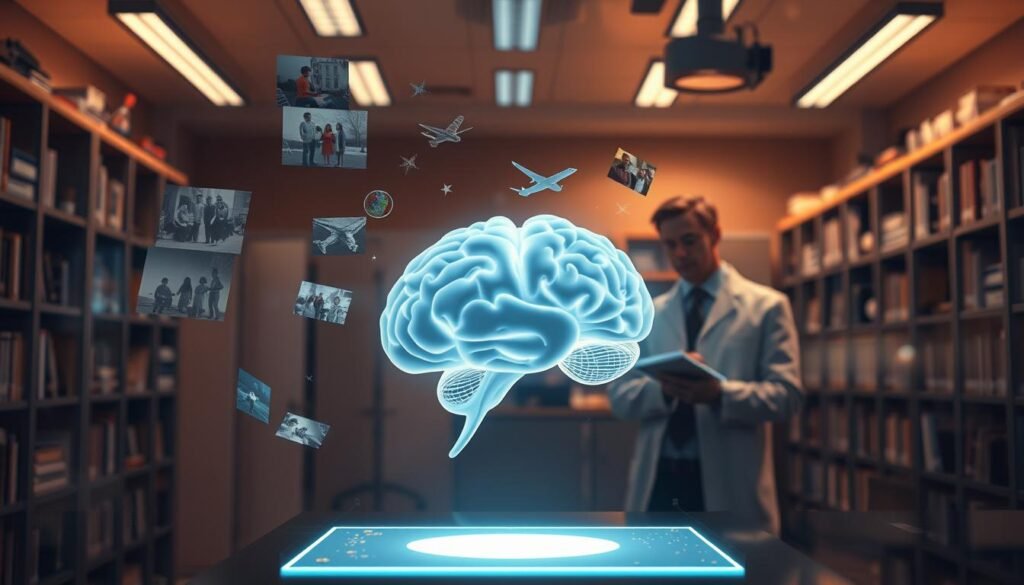
Memory traces and why recall is reconstructive
Experiences create physical traces, often called engrams, that support later recall. These traces act as clues we use to rebuild a past event.
The rebuilt memory blends those traces with current context and prior knowledge. That mix explains why recall can drift or gain errors over time.
Consolidation: stabilizing stored information
Consolidation is the slow process that stabilizes newly encoded items into stored information. Time, sleep, and repeated retrieval strengthen these traces for long-term memory.
In study practice, spacing and reinforcement help consolidation so facts stay accessible when we need them.
What Alzheimer disease reveals about memory systems
Alzheimer disease often first impairs episodic memory—our recall of events—while semantic memory (facts and meanings) may remain clearer early on.
That pattern shows us that what looks like “memory loss” can reflect different vulnerabilities across encoding, storage, and retrieval pathways.
- Engrams support retrieval but do not record perfect copies.
- Consolidation converts fragile traces into more stable stored information.
- Clinical patterns (like in alzheimer disease) reveal system-specific breakdowns.
| Concept | Primary Role | Practical note |
|---|---|---|
| Engrams | Physical traces for recall | Built by early encoding and strengthened by rehearsal |
| Consolidation | Stabilize new traces | Needs time, sleep, and spaced practice |
| Episodic vs Semantic | Events vs facts | Episodic often declines earlier in alzheimer disease |
Bringing It All Together: Using Encoding to Strengthen Learning Every Day
To strengthen our memory, we make deliberate choices when we learn. We use clear encoding steps to turn raw information into meaningful cues.
That simple process links encoding → storage → retrieval and makes later recall more reliable. We should add meaning, images, and associations as we study.
Plan retrieval while you encode: create questions, categories, or spatial anchors that match how you will test yourself. Good cues speed access and reduce guesswork.
Try a short routine: brief effortful study, spaced review, and regular self-testing. This pattern boosts storage and helps information survive interference.
Selectivity is normal — choose what matters, make it distinctive, and practice recalling in real contexts. In short, improving encoding is the most practical lever we have to improve learning memory and lasting recall.