
Proactive Interference Psychology Definition
We define the term simply: it is a case where older learning makes new learning harder to recall. This matter affects daily learning, from classroom study to on-the-job training across the United States.
In this view, a specific type of interference acts like a memory overlap. Old items keep “winning” when we try to use updated information.
Baddeley’s interference theory explains forgetting as memories disrupting one another. That theory helps us see why older traces can block fresh ones during recall.
On this page we will offer clear meanings, contrast with retroactive effects, show real examples and research, and suggest practical steps to reduce the problem in study and work.
What proactive interference means in psychology
Older learning can sometimes block what we try to remember next. In simple terms, proactive interference happens when earlier material makes learning new information harder.
Working definition: when old memories disrupt new learning
We use a practical working definition: proactive interference is when previously learned material reduces how well we encode or recall new information. This is most clear when the old and new items are similar.
Why psychologists classify it as an interference phenomenon
Researchers call it an interference effect because different memories compete during encoding and retrieval. The issue is not laziness but rivalry between traces in our memory systems.
- Older memories often intrude forward and offer the old response instead of the updated one.
- This can happen while learning new facts and later during recall, when we must select among competing memories.
- We see the role of this phenomenon in everyday forgetting, though it is not the only cause.
Where proactive interference fits in interference theory of forgetting
In the bigger picture, forgetting often arises when stored items compete in long-term memory. We treat this as a normal part of how memory works rather than a sign of loss.
Interference as a cause of forgetting in long-term memory
The theory holds that similar traces disrupt each other and cut retrieval chances. Baddeley (1999) framed forgetting as rival memories that reduce retention and recall.
One branch of the theory explains forward effects, while another explains backward effects. Both help us map common forgetting patterns seen in study and work.
How memories can become confused during encoding
During encoding, related information may merge or distort. When details are stored close together, later mix-ups grow more likely.
Often forgetting here means retrieval failure — we cannot access the trace — not total erasure. Attention and selection mechanisms decide which memory wins when competition is high.
| Mechanism | Typical effect | Practical sign |
|---|---|---|
| Competing traces | Lower recall of recent items | Old answers come to mind first |
| Encoding confusion | Blended or distorted information | Mixing similar facts or dates |
| Retrieval failure | Access problem, not loss | Feeling that the fact is “on tip of tongue” |
We note that attention, rehearsal, and clear cues can shift which memory wins. Future sections outline study tips and research that test these mechanisms.
Proactive interference vs retroactive interference
Knowing which memory arrived first helps us tell two common cases apart. We use a simple time check to separate forward from backward effects.
Forward-acting interference
We define proactive interference as forward-acting interference over time, where earlier learning intrudes on later learning or recall.
Backward-acting interference
By contrast, retroactive interference occurs when later learning makes earlier material harder to retrieve. New information can overwrite or mask what came before.
Why similarity between items raises the risk
When items are alike — similar words, phone numbers, or routines — the same cues trigger multiple responses. That overlap increases competition and slows or blocks recall.
- Rule of thumb: ask which memory came first in time to label the effect.
- Example case: changing a password (older answers block the new one) versus forgetting an old password after adopting a new one.
- These effects show up in school, workplace training, and when switching similar tasks.
| Type | Which came first? | Typical sign |
|---|---|---|
| Forward-acting | Earlier | Old response replaces new |
| Backward-acting | Later | New learning hides old |
Proactive Interference Psychology Definition in everyday terms
We notice that past learning can quietly push newer answers out of reach when we try to recall them. This is common and easy to describe in plain language.
Old information blocks retrieval of the new version when our brain auto-suggests the older response. That clash creates the “I know it, but I can’t access it” feeling.

Old information blocking retrieval of new information
When similar facts or routines repeat, the older trace often wins at retrieval. People reuse formats like passwords and dates, so the brain favors the familiar reply.
Why it feels like “I know it, but I can’t access it”
The tip-of-the-tongue feeling happens because competing candidates keep popping up. Our working memory and long-term memory fight over which item to return.
- We translate the formal term into plain words: older information takes priority.
- Stress can worsen the issue, but calm states still show the same effect.
- Recognizing the pattern helps us pick strategies to protect new information instead of blaming our ability.
Common real-life examples we see in the United States
Everyday slip-ups show how old habits can push new facts out of reach. Below we list familiar cases where proactive interference makes routine tasks harder.
Forgetting a new password because older passwords intrude
We often update passwords for email, banks, or streaming services but then type an older password by habit. Repeated attempts cause login failures and wasted time.
Writing last year’s date out of habit
Right after January 1, many people write the prior year. Years of practice make the old response automatic before the new one becomes routine.
Mixing up old and new phone numbers
When area codes or first digits match, we substitute the old number. This classic example shows how similar numbers raise recall difficulty.
Foreign currency confusion while traveling
Home currency habits interfere with recognizing new coins and bills. We misjudge values and convert mentally at the wrong rate.
Teachers mixing up students’ names across school years
Classroom seating or repeated names make teachers call a new student by a former pupil’s name. These errors are common and tied to repeated cues.
- These examples show interference in work, school, and travel.
- They are normal, widespread, and easy to spot across people and time.
| Situation | Typical sign | Why it happens |
|---|---|---|
| Password change | Repeated login failures | Old habit wins |
| New phone number | Dialing old number | Similar digits cue old recall |
| Classroom names | Wrong student called | Prior year seating or names |
What makes proactive interference more likely
A few clear factors make it more likely we’ll call up an old answer instead of the new one. We list the key risks so readers can spot when memory competition is most probable.
High similarity in words, numbers, or routines
Similarity is the biggest risk factor. When words, number formats, or routines match, the same cues trigger multiple candidates.
That overlap raises interference and lets the older trace win at recall.
Short time gaps and repeated exposure
Updating information quickly gives little time for the new trace to settle. The older version stays active for longer and intrudes more often.
Repeated exposure to the prior information also strengthens it, so the new information struggles to replace it.
When multiple tasks or subjects compete for attention
Switching between similar tasks or subjects increases competition in working memory and lowers our control over retrieval.
Chandler (1989) showed students studying related courses at the same time face higher rates of interference.
- Similarity of material raises cue overlap.
- Short time and repetition keep older information strong.
- Competing tasks tax working memory and control.
| Risk | Typical sign | Why it happens |
|---|---|---|
| Similar words | Wrong word recalled | Cue overlap |
| Quick change | Old answer persists | New trace weak in time |
| Multiple tasks | Mix-ups between tasks | Working memory limits |
Memory systems involved: working memory and long-term memory
We look at how two memory systems share work and why that sharing sometimes causes confusion. Short-term storage holds active items while longer systems store durable information over time.
Limited-capacity working space and competition
Working memory has a small capacity. Multiple items compete there, which creates selection problems and early errors.
- Several items vie for the same cues, raising interference during recall.
- When working space fills, the older, rehearsed item often wins the choice.
- This selection issue can later appear as a long-term memory retrieval error.
Why older information can feel stronger
Long-term memory traces gain strength with rehearsal and time. Repetition boosts retention and makes older information more accessible.
That accessibility raises the odds the older response appears, even if new information is correct. We can reduce this by giving new material distinct cues and by spaced practice.
| System | Typical effect | Practical fix |
|---|---|---|
| Working memory | Item competition | Chunking, limit multitasking |
| Long-term memory | Strong rehearsal bias | Distinctive encoding |
| Interaction | Selection errors | Spaced retrieval |
Brain mechanisms researchers link to proactive interference
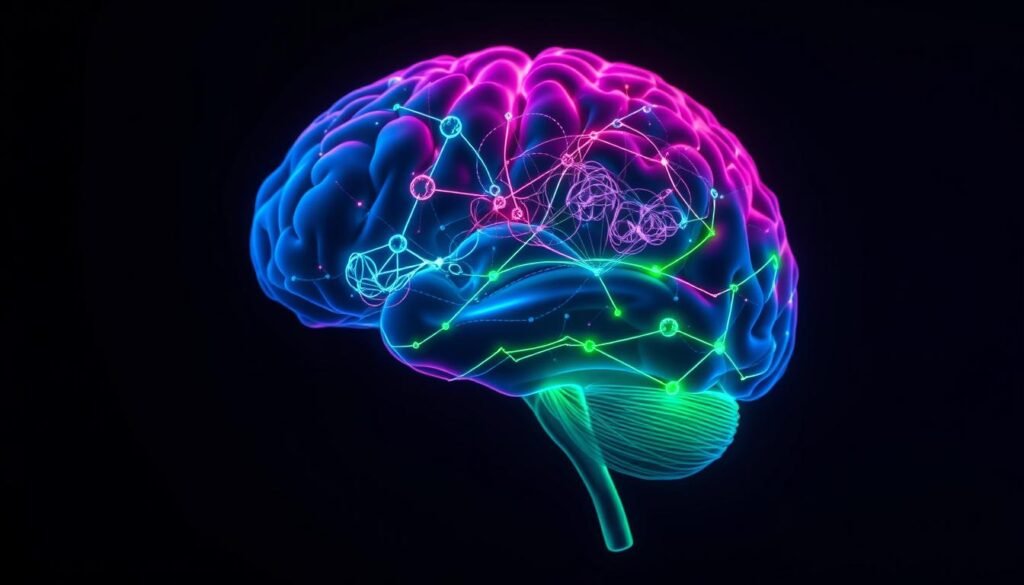
Several neural systems help us sort competing memories, and their limits shape recall. Researchers link difficulty updating memory to control and storage processes in the brain.
Prefrontal cortex and attention control under load
The prefrontal cortex supports attention and working memory when tasks demand selection among options. Under high load, this control system weakens.
When control wanes, older memories can intrude and slow our responses.
Hippocampus and updating long-term memory
The hippocampus helps form and update long-term memory traces. It matters when we need a new version to replace an old association.
Stronger prior traces can resist updating, making the hippocampal role central to successful change.
How overload reduces control over retrieval
Too many similar tasks, little rest, or frequent switching overloads control systems. That overload lowers retrieval control and raises intrusion errors.
As control weakens, performance drops: answers slow, substitutions rise, and confidence falls.
- Core story: interference grows when control systems fail to filter rivals.
- Prefrontal cortex supports selection under load; hippocampus supports updating.
- Overload from multitasking or fatigue lowers retrieval control and harms performance.
| Brain area | Primary role | Effect when strained |
|---|---|---|
| Prefrontal cortex | Attention control, working memory | Slower selection, more intrusions |
| Hippocampus | Forming and updating long-term memory | New traces fail to replace old |
| Combined systems | Coordinate retrieval and update | Reduced performance on similar tasks |
What research and studies show about interference effects
Empirical work shows that study timing and similarity shape how well new facts stick. We review key research that tests these patterns in students and in the lab.
Chandler’s student study findings
Chandler (1989) found that students who studied similar subjects at the same time showed more confusion. Their test performance fell when topics overlapped.
In short, studying related courses concurrently raises the chance of mixing material and lowers accuracy on exams.
Baddeley’s view on memory disruption
Baddeley (1990/1999) frames the effect as memory disruption: similar tasks create rival traces that reduce recall. He also warns that lab tasks can be closer together than real-life learning.
Why researchers use word-list tasks
Word-list paradigms let us control similarity, timing, and competing information. That control makes it easier to measure outcomes such as slower recall, more intrusions, and reduced accuracy.
- Typical effects: slower recall, more intrusions, and lower accuracy when lists overlap.
- Lab tests give precise measures; classroom studies show ecological relevance.
- This body of studies explains why overlap in modern schooling and training raises problems for updating knowledge.
| Study | Method | Key result |
|---|---|---|
| Chandler (1989) | Students studying similar courses concurrently | Increased confusion and lower exam performance |
| Baddeley (1990/1999) | Review and lab experiments with controlled lists | Memory disruption when tasks are highly similar; note on spacing |
| Word-list paradigms | Controlled lists varying similarity and timing | Slower recall, more intrusions, reduced accuracy when overlap occurs |
Key evidence example: what Postman’s paired-word study demonstrates
Postman’s paired-word work gives a clear lab test of how new learning can disrupt what came before. In his 1960 study, participants first learned simple pairs such as “cat–tree.”
We describe how the groups differed. The experimental group learned a second list where the cue stayed the same but the paired word changed (cat–glass). The control group learned only the first list and had no re-pairing step.
How the experimental and control groups differed
The control participants recalled the original pairs more accurately than those in the experimental condition. New pairings in the experimental group made recall for the first list worse.
What the results imply about retention and competition
The result shows that when items share a cue but lead to different targets, competition rises and retention of the original pair falls. This lab example operationalizes how one set of learning can change access to earlier items.
Translating lab logic into real-world learning
In practice, if we re-pair a familiar cue with a new response—like a new password or a revised procedure—we should expect some confusion at first. The study helps us design learning and review to protect new items and reduce mistaken retrieval.
- Example design: paired words vs. re-paired words to test recall.
- Result: control group better retention of original items.
- Practical takeaway: distinct cues and spaced review reduce competition.
| Condition | Procedure | Key finding |
|---|---|---|
| Control | First list only | Higher recall of original words |
| Experimental | Second list with changed pairs | Lower retention of first-list items |
| Implication | Shared cues, new targets | Greater competition, poorer recall |
Effects on learning, performance, and retrieval in daily tasks
Switching between similar skills commonly produces short periods of slower recall and extra errors. In our experience, these effects show up quickly when people move from one tool or routine to another.
How interference shows up as slower recall and more errors
We notice three visible signs: delayed answers, hesitation, and intrusion errors where the old response replaces the new one.
These signs reduce performance on simple tasks like filling forms or following a revised policy.
Why “switching” skills can temporarily lower performance
When we switch workflows or language sets, retrieval competition grows. The brain must choose among candidate memories and the familiar answer often wins.
This can look like careless mistakes, but it is a predictable memory dynamic. The hit to performance is usually short lived if we strengthen the new memory.
- Common task examples: updated forms, new operating procedures, and changed step sequences.
- Impact: slower task completion, more corrections, lower confidence.
- Fix: distinct cues and spaced practice speed recovery.
| Effect | Typical sign | Everyday example |
|---|---|---|
| Slower retrieval | Longer pauses | Typing an old password |
| Intrusion errors | Wrong but familiar answer | Using prior form fields |
| Lower performance | More corrections | Swapping steps in a workflow |
Age and individual differences in proactive interference
Memory clutter grows over years, and that crowding can change recall patterns. As we collect more similar facts, routines, and logins, the pool of candidates at retrieval gets larger.

Why it often feels stronger with age
Over time, a greater number of related memories creates more competition during recall. Older adults who have changed addresses, phones, or passwords many times may notice more intrusions.
What developmental research and studies suggest
Childhood and adolescence show shifts in control systems. Work by Kail and others indicates that attentional selection and retrieval ability improve through the teen years, then change again later in life.
- Individual history matters: job routines and repeated tasks raise overlap even within the same age group.
- This is not a clinical sign but a normal case of competing traces we can manage.
| Group | Common sign | Underlying mechanisms |
|---|---|---|
| Younger people | Faster updating | Developing control and selection |
| Older adults | More intrusions | Larger number of similar memories |
| Individual differences | Varying error rates | Work history, routines, attention |
Ways we can reduce proactive interference
Small changes in how we encode new material make a big difference for recall later. We focus on practical ways to protect new information and ease retrieval when cues overlap.
Active attention and deliberate encoding
We slow down and label the new version when something changes. Noticing the difference—say, the new password format—helps working memory store distinct features.
Add novelty: mnemonics and distinctive cues
Give new information a unique tag. A short phrase, a vivid image, or a different format makes the new item stand out against older, similar entries.
Retrieval practice and self-testing
Testing forces selection of the new target and strengthens retrieval. Frequent, short quizzes beat rereading for making the recent memory easier to access.
Overlearning and spaced practice
Practice past initial success to help the new response compete. Space review across days so the new trace settles apart from the old one.
- Benefits: reduces competition in working memory and boosts retention.
- Goal: strengthen control so the correct item is chosen at recall.
- Combine methods: distinct cues + self-testing + spacing for best results.
| Strategy | Primary effect | When to use |
|---|---|---|
| Deliberate encoding | Clearer new cues | At first exposure to new information |
| Retrieval practice | Stronger retrieval | Daily short tests after learning |
| Spaced overlearning | Improved retention | After initial mastery, across days |
Related memory concepts people confuse with proactive interference
Readers often mistake similar recall failures for the same underlying process. We will separate nearby ideas so you can label your own experience correctly.
Output interference in sequential recall
Output interference shows up when accuracy drops as we list items one after another. The act of repeated retrieval tires recall and causes more errors.
Example: naming many grocery items in sequence and then forgetting the last few.
Dual-task interference when doing two things at once
Dual-task interference comes from divided attention. Performance falls because we split cognitive resources, not because old learning blocks new information.
Example: texting while following spoken instructions leads to mistakes on both tasks.
False memories and misattribution versus competition
False memories involve wrong source or fabricated details. These errors are not just competition among similar items; they are misattribution or confabulation.
Example: recalling an event that never happened because a story and a real event mixed in our mind.
Memory decay and the forgetting curve
Decay theory (Ebbinghaus) explains forgetting as time-based fading of traces. That view contrasts with interference theory, which ties errors to competing information during retrieval.
Example: not using a foreign word for months and losing ease of recall due to time rather than competing words.
- We also note that some authors label certain effects as “proactive inhibition”; that term overlaps with inhibition concepts but should not be used as a catch-all.
| Concept | Core cause | Quick example |
|---|---|---|
| Output effect | Serial retrieval fatigue | Forgetting last items on a list |
| Dual-task | Divided attention across tasks | Typing while listening to directions |
| False memory | Source misattribution or fabrication | Remembering an event that didn’t occur |
| Decay | Trace fading over time | Words lost after long disuse |
Limits of interference theory and what it doesn’t fully explain
Not every forgetting case fits neatly under the interference model, and that gap matters for how we use research. We must be clear about what the theory can and cannot tell us.
Why the theory can be light on cognitive-process detail
The theory describes a pattern: memories compete. It says less about the exact mechanisms that select one trace over another.
That makes it hard to predict which memory will win in a specific task or to design fine-grained remedies.
Ecological validity concerns with list-learning studies
Many classic studies use word lists or paired items. Those lab tasks compress time and similarity in ways that differ from daily learning.
Baddeley warned that tight timing may inflate effects compared with real-world learning.
Open debates in current research
- Some work shows strong role for interference in forgetting.
- Other scholars, such as Anderson, ask how much forgetting the phenomenon explains overall.
- We should weigh lab findings alongside classroom and workplace data before changing practice.
| Limit | Why it matters | Practical note |
|---|---|---|
| Cognitive detail | Few process-level claims | Be cautious when prescribing fixes |
| Ecological fit | Lab tasks compress time | Test methods in real tasks |
| Scope of role | Debate over how much it explains | Use as one of several explanations |
Taking the definition with us into real learning situations
When we change a routine, past habits can briefly win out as similar cues trigger the older answer; this is a clear case of proactive interference that affects daily learning.
Quick checklist: is the new information like the old? Did we switch it recently? Are we juggling tasks in a short time window? If so, interference risk is higher.
In the moment, pause and label the new version. Deliberate encoding helps working memory store distinct features and speeds later retrieval.
At work or school, space related topics and separate similar tasks across time to protect performance and reduce cue overlap.
We remind people this is normal. Treat a dip after an update as interference and use focused practice rather than blame — the right steps restore performance fast.