
Latent Learning Psychology Definition
We introduce a clear, glossary-style entry on an important concept in psychology. We define latent learning as knowledge gathered from the environment that did not appear in behavior right away but surfaced when motivation or circumstances changed.
Our aim is to explain how this kind of learning can happen without reinforcement. In plain terms, no immediate reward or punishment needed to produce stored information that later guides action.
We will outline the historical tests that proved this idea, such as classic maze studies that showed animals formed mental maps before they ever had reason to show them. This sets expectations: a concise definition, origins, and experimental evidence.
Finally, we frame the idea as “learning first, performance later.” We link the concept to everyday examples, like quietly picking up a route and using that knowledge when needed.
– We define the concept and how it differed from strict stimulus-response views.
– We note that reinforcement was not required for knowledge to form.
– We preview classic experiments and real-life links to follow in later sections.
Latent Learning Psychology Definition and What Makes It Unique
We explain a form of learning that forms internal knowledge even when no immediate reward or punishment is present. This hidden acquisition can later guide action once motivation rises.

Learning without reinforcement, reward, or punishment
We show that this type of learning occurs without reinforcement. Organisms gather information from an environment and store it, even when no reward appears.
Why this learning isn’t obvious until motivation changes performance
We separate learning from performance. Knowledge may sit unused until a strong motivation — hunger, safety, or a goal — triggers visible behavior.
Key terms we use
To follow the experiments and theory, we use a small set of terms consistently.
- stimulus — an event or cue that the subject encounters
- response — the action taken after a cue
- environment — the stable setting where information is gathered
- information and knowledge — the stored content that later shapes behavior
We also contrast this with observational learning: both pick up information, but one often needs social cues or visible rewards. Here, stored maps and facts form through internal processes and reveal themselves only when circumstances demand action.
Where the Concept Came From: From Blodgett to Edward Tolman
We trace the origin to early maze work that changed how psychologists thought about how animals form knowledge over time.
Hugh C. Blodgett and early maze observations
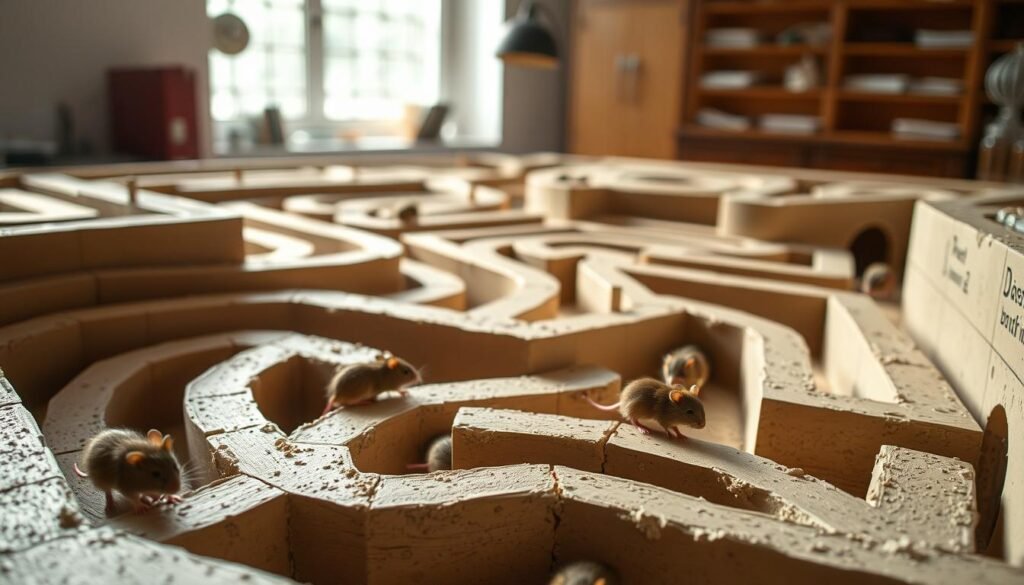
Hugh C. Blodgett in 1929 noted that rats sometimes showed better maze performance after days of exposure, even when no reward had been given.
Those patterns suggested that experience accumulated quietly and surfaced later when conditions changed.
Edward Tolman’s challenge to behaviorism
In the 1930s and 1940s, Edward Tolman ran systematic experiments with rats in mazes that popularized the idea.
Tolman argued that animals built internal maps and that reinforcement was not the only way to acquire routes.
- Blodgett’s rodent reports planted the seed for a formal concept.
- Tolman’s maze studies made the case testable across days and time.
- The shift moved theory toward internal information processing rather than pure stimulus–response chains.
Tolman and Honzik’s Rat Maze Experiments and the Role of Reinforcement
We review a landmark study where three groups of rats ran a complex maze so we could test whether route knowledge forms without immediate reward.

The aim and setup
The aim was to see if rats learned routes beyond simple stimulus–response patterns. Each day the rats ran the maze with a food box at the end.
How the procedure worked
Three groups ran the maze across days. Group 1 received food every day (rewarded). Group 2 had no food for Days 1–10 and food on Days 11–17 (delayed reward). Group 3 never received food.
- All groups explored the same routes each day.
- Food functioned as the reinforcer when it appeared.
- Researchers tracked maze performance and errors across days.
Results and interpretation
At first, the delayed reward group behaved like the no-reward group. After Day 11 their performance improved sharply and sometimes beat the continuously rewarded group.
Researchers concluded the rats had formed a learned maze during the early, unrewarded days. Food and motivation revealed stored information; it did not create all learning on the spot.
| Group | Reinforcement | Outcome across days |
|---|---|---|
| Group 1 | Food Days 1–17 | Steady maze performance |
| Group 2 | No food Days 1–10; food Days 11–17 | Sharp improvement after Day 11 |
| Group 3 | No food Days 1–17 | Low motivation; little improvement |
The authors proposed mediational processes: an internal step between stimulus and response where rats processed spatial information. This finding challenged strict reinforcement-only theories of learning in animals.
Cognitive Maps as the Mechanism Behind Latent Learning
We examine how internal maps guide behavior when animals or people face blocked paths or new goals. Tolman coined the term cognitive map to describe an internal representation of landmarks and spatial relations that stores usable knowledge.
What a cognitive map is and how it supports shortcuts and flexible routes
A cognitive map is an internal map of the environment. It records cues, landmarks, and spatial links. This map lets an animal take a shortcut or choose an alternate route when the usual way is blocked.
Rats, mazes, and internal maps: what “learning rats” implies
Rats in Tolman’s maze studies built maps during low-stakes exposure. When motivation appeared, their stored information produced rapid gains. That pattern meant these learning rats were forming internal knowledge, not just chaining responses.
Humans build cognitive maps too: commuting routes, buildings, and objects over time
We form maps of streets, buildings, and objects through repeated trips. Over time, stored information becomes obvious when we need to find a specific place. This mechanism shifted theory toward internal processes and flexible behavior.
How We See Latent Learning in Everyday Life and Why It Still Matters
Everyday moments often reveal that we carried information for weeks before using it.
As an example, children who watch parents drive may later act out driving without any reinforcement at the time of watching. That display shows stored knowledge surfacing when play or curiosity creates motivation.
Other examples include spotting a water valve while tidying, learning office stair routes over time, or finding a bookshelf at school months later. These cases show how a quiet process in the environment shapes later behavior.
We separate this from observational learning by noting that reinforcement is not required during the original exposure. In short, latent learning helps explain sudden changes in behavior because the knowledge was already present; motivation simply made it visible.